

РАЗРАБОТКА МЕТОДИКИ ОЦЕНКИ ФИНАНСОВОГО ПОТЕНЦИАЛА ОРГАНИЗАЦИИ
Aннотация
Статья посвящена важной проблеме финансового менеджмента – оценке финансового потенциала организации. Актуальность работы определяется функционированием организаций в условиях нестабильной макроэкономической среды, высокой ключевой ставки и недоступности кредитных ресурсов для российского бизнеса в 2025-2026 гг., вследствие чего возникает необходимость формирования финансовых ресурсов организации преимущественно за счет внутренних источников. Для выявления и использования скрытых резервов повышения финансового потенциала необходима стратегическая оценка финансового потенциала организации. Целью проводимого исследования является комплексный стратегический анализ финансового потенциала организации, поэтому данная статья посвящена разработке методики оценки финансового потенциала организации, которая основывается на формализации факторов, оказывающих влияние на финансовый потенциал, таких как: масштабы деятельности предприятия, доступность рынков сбыта, структура активов, наличие заемного капитала, применение государственного финансирования. Результатом статьи является разработанная методика, преимущество которой заключается в ее адаптивности и применимости к предприятиям любых отраслей и масштабов деятельности.
Ключевые слова: финансовый менеджмент, финансовый потенциал организации, методика оценки, стратегическая характеристика, формирование финансового потенциала
К сожалению, текст статьи доступен только на Английском
Introduction
The relevance of researching the financial potential of an organization and the need to develop a methodology for its assessment is due to a number of reasons. Firstly, effective management of the financial potential of an organization is essential in today’s economy: sanctions pressure, the need for structural transformation, the technological sovereignty enhancement and international economic links realignment enforce organizations to generate financial capabilities primarily from internal sources. This explains why Russian scholars began to focus on the phenomenon of financial potential mainly after 2014, when economic sanctions were imposed on the Russian Federation.
Secondly, financial potential, being the process of accumulating financial resources, directly affects the ability of an organization to attract and utilize these resources for investment projects, ensuring its resilience and competitiveness in an unstable macroeconomic environment with a high key rate. Data on the reduced availability of credit resources for Russian business in 2025-2026 underscore the need for a strategic assessment of financial potential of enterprises, based on a detailed analysis of the factors influencing it, in order to identify hidden reserves for enhancing financial potential.
Thirdly, the modern Russian financial system requires organizations to implement effective financial management, including qualitative and quantitative accounting for factors influencing financial potential. The strategic assessment of financial potential should be based not so much on the value of individual calculated indices as on their incremental amount over the period under review, which will enable to determine the capacity of the organization to achieve long-term goals and successful development. A high level of financial potential depends not only on a sufficient quantity of financial resources, but also on their competent use. Only those economic entities that are capable of reproducing the necessary assets in the shortest possible time, in full and with minimal losses, provided that all resources are utilized in operations and used effectively, can create the financial potential for development under any economic conditions, including difficult ones.
The reasons given for the relevance of studying the financial potential of an organization and the need to develop a methodology for assessing financial potential are confirmed by the fact that issues of financial potential in modern economies (especially foreign) have been studied relatively little. In modern science there is a description of the economic essence of financial potential [Barsegova I.V., 2011; Volkov A.M., 1976; Gilyarovskaya L.T., 2017; Kolchina N.V., 2016; Minaeva O.A., 2008; Suverneva E.B., 1999; Levytskyi S., Mykhailyk D., Zherlitsyn D., 2019; Nahorniuk O.V., 2017]; a description of the management of financial potential and its assessment [Amirov E.R., 2019; Grebennikova V.A., 2019; Kolchina N.V., 2016; Loktionova M.A., 2017; Nemchinov A.A., 2017; Sukhova L.F., 2016; Levytskyi S., Mykhailyk D., Zherlitsyn D., 2019]; analysis of the methodology for assessing the financial potential of a business entity [Minaeva O.A., 2008; Nikolaevskaya O.A., 2013; Sukhova L.F., 2016; Levytskyi S., Mykhailyk D., Schwartz E., Zherlitsyn D., 2019]; a description of factors influencing the financial potential of a business entity [Amirov E.R., 2019; Barynin A.V., 2010; Boltaev Sh., 2019; Kolchina N.V., 2016]; analysis of the financial potential of an organization in terms of innovation
[Korovin A.V., 2011, Schwartz E. S., 2011] and the financial strategy of a business entity [Ivanchenko O.G., 2010; Kaplan R.S., Norton D.P., 1992; Porter M.E., 2008]; description of financial potential in terms of a regional perspective [Kondratovich D.L., 2022].
Aim of the Study
The main objective of this study was a comprehensive analysis of the financial potential of an organization and the development of practical recommendations to improve the efficiency of financial capacity management in the system of financial management of the organization. To achieve this objective, it is necessary to develop a methodology for assessing the financial capacity of an organization, which is the subject of this article.
Research Materials and Methods
The information base for the study consisted of the financial indicators of the enterprises under investigation, data from the Federal State Statistics Service, and data on sector-specific financial indicators of the enterprises. The methodology for assessing the financial potential of an organization was studied and developed using historical and comparative analysis, statistical methods of data analysis, tabular and graphical procedures.
Results and Discussion
Financial management is the management of financial resources and activities of the organization aimed at achieving its strategic and ongoing objectives [Polyak G.B., 2014]. Financial potential research in the financial management system is the key element for assessing and planning financial activities of the organization. The strategic assessment of financial potential is carried out not in a short period of time, but over an interval. The longer the interval during which the growth of financial potential is observed, the higher the final assessment. A certain (and increasing!) amount of financial potential serves as a guarantee for the successful implementation for the development strategies of the organization.
The financial potential of an organization within the financial management system is a strategic characteristic of the financial capacity of an organization, which can be determined through an integrated assessment of factors incremental values influencing financial potential. The factors whose growth directly influences the growth of financial potential are presented in Figure.
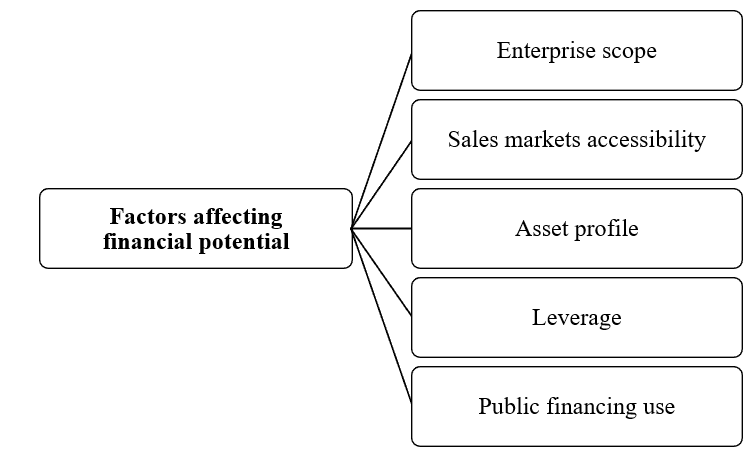
Рис. Факторы, влияющие на финансовый потенциал организации
Fig. Factors affecting the financial potential of an organization
Scource: compiled by the author
In accordance with the scheme presented in Figure 1, the increase in financial potential is determined by assessing the identified factors and the amount of the increase obtained for each factor over the period.
The identified factors must be decomposed and expressed as a system of ratios, the calculation of which will provide a qualitative characterisation of the financial potential of an organization. At the same time, the methodology for assessing the financial potential of an organization within the financial management system must remain flexible and reflect the specific features of the economic activities of economic entities in various sectors, by adjusting the set of ratios, as well as by comparing the results of calculations not with normative indicators, but with industry averages.
Thus, to assess the financial potential of an enterprise within the financial management system, the following ratios were selected from the factors described above:
Enterprise scope
The enterprise scope can be assessed most comprehensively through business activity ratios: like profitability ratios, they reflect range of activity, but are more closely linked to revenue. Analysing revenue using business activity ratios allows us to assess the ability of a business entity to maintain its current asset level [Blazhevich O.G., 2018, p. 32], which is of fundamental importance for the further assessment of the financial potential of an organization within the financial management system. The business activity of an enterprise is characterized by turnover rates, which consist of turnover ratios and turnover duration.
The current assets turnover ratio (velocity of turnover) is calculated as follows:
CATR = Sales revenues / Average value of current assets (1).
This ratio indicates the turnover rate of current assets of an enterprise. The average value of assets is calculated as the arithmetic mean at the beginning and end of the period.
The accounts receivable turnover ratio is calculated using the following formula:
ARTR = Sales revenues / Average accounts receivable (2).
This ratio indicates the number of times sales revenues exceed average accounts receivable.
The inventory turnover ratio is calculated as follows:
ITR =Cost of goods sold / Average inventory (3).
This indicator reflects the rate of inventory turnover and enables an assessment of the appropriateness of the current level of this asset [Blazhevich O.G., 2018, p. 32].
There is no set standard for turnover rates, as they depend on the industry-specific features of the economic entity. A higher figure compared to competitors indicates a more intensive use of assets [Blazhevich O.G., 2018, p. 32].
2. Sales markets accessibility
The link between the accessibility of sales markets and the financial potential of an enterprise is an important aspect of strategic business management. The sales markets accessibility directly influences financial performance of a company and its capacity for growth and development.
Market share is the indicator that most fully reflects the markets accessibility for a specific enterprise. This indicator is calculated using the following formula:
MS= Enterprise sales volume / Total industry sales volume (4).
An increase in market share may indicate that the company is becoming more accessible and competitive in the market [Voronov D.S., 2015].
3. Asset profile
This factor directly influences the resource composition of financial potential: for example, enterprises in the perfumery and cosmetics industry are characterised by a high proportion of inventories, which results in a higher liquidity ratio for enterprises in this industry, and this subsequently affects the final value of financial potential when it is calculated.
The asset structure can be assessed by calculating liquidity ratios using the following formulas:
CLR = Current assets /Short-term liabilities (5).
QLR= (Short-term accounts receivable + Short-term financial investments + Cash) / Short-term liabilities (6).
ALR= (Short-term financial investments + Cash) / Short-term liabilities (7).
Liquidity is the ability of an asset to be converted into cash. Assets are classified as highly liquid, low liquid and illiquid. The more easily and quickly an asset can be redeemed for its full value, the more liquid it is. The current (CLR), quick (QLR) and absolute (ALR) liquidity ratios reflect the ability of the company to settle short-term liabilities using various combinations of current assets.
4. Leverage
The more of its own financial means a company has - primarily profits - the more secure it can feel in the market. At the same time, the more funds an organization can raise in the capital market, the greater its financial capacity is - but financial risk is also increasing. In this regard, it is advisable to assess the company capital structure, i.e. the ratio of equity to debt financing, by calculating the following ratios [Dubonosova A.N., 2018]:
1) The autonomy ratio (AR) indicates the extent to which the company is independent of borrowed capital (target value > 0.5):
AR = Equity / Balance sheet total (8).
2) Debt ratio (DR) (target value < 0.5):
DR = (Long-term liabilities + Short-term liabilities) / Balance sheet total (9).
If the leverage ratio in the balance sheet total decreases, this indicates a strengthening of financial resilience of the enterprise
5. Public financing use
Public finance plays an important role in shaping the financial potential of organizations. Public funding of research and development contributes to the introduction of innovations in products and services, which enhances the competitiveness and financial performance of enterprises, and consequently their financial potential.
To assess its impact on the financial potential of an organization, it is necessary to calculate the profitability ratio of public financing:
PRPF = Profit / Events costs (10)
The profitability of public finance shows how effectively public investments in an
organization are used.
To provide an overall assessment of an enterprise and/or to rank enterprises according to their level of financial potential, a ranking table is compiled using the following categories of financial potential: low, medium and high.
It should be emphasised that a strategic assessment of financial potential must be based on an evaluation of the financial resource accumulation process, which allow us to identify the capabilities of the organization to achieve long-term goals and advancement. Accordingly, it is not the value of a particular financial indicator itself that is to be assessed, but the incremental amount over the researched period (quarter, year, etc.).
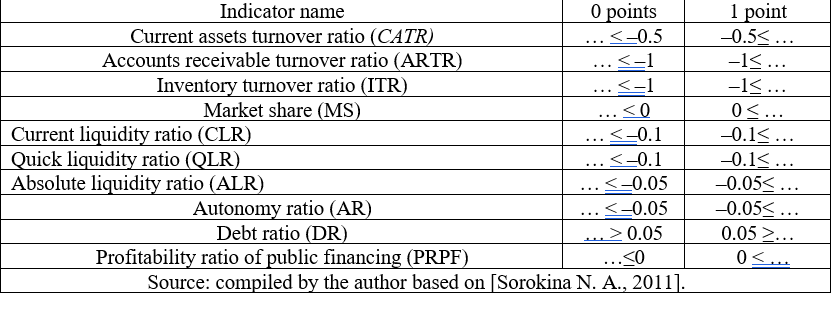
The distribution of ratings for each type of financial potential is presented in Table.
Таблица
Рейтинговая оценка финансового потенциала предприятия по финансовым показателям
Table 1
Rating assessment of the financial potential of an organization based on financial indicators
Source: compiled by the author based on [Sorokina N. A., 2011].
The points per each organization are allocated according to the Table. The allocation of different boundaries for indicators
is explained by the degree of influence of a decrease (growth) of a specific indicator on financial potential: an insignificant decrease (growth) of an indicator relative to the industry norm will not lead to a deterioration in financial potential. For example: the average data of receivable turnover for the period 2020–2023 for companies with a business activity classified under All-Russian Classifier of Economic Activities-2 «20. Manufacture of chemicals and chemical products», which includes companies with All-Russian Classifier of Economic Activities-2 «20.42. Manufacture of perfumes and cosmetics», which are the subject of this study, was 6.08 [17]. In this case, a decrease of 1 in the indicator would constitute a slight deterioration (Table 1). By analogy, the average autonomy ratio for 2020–2023 is 0.33, in which case a slight deterioration of 0.05 would be the reduction of the calculation for a particular company (Table).
It is important to reiterate that scores are assigned according to the magnitude of the indicator’s incremental amount over the period under review. In other words, it is not the ratio itself that is assessed, but the extent to which it has changed over the period under review. For example, if the inventory turnover ratio of company «A» decreased by 0.6 over the year (i.e. the difference between the figure at the end of the year and the figure at the start of the year is ‘–0.6’), then it is awarded 0 points; if the ratio remained unchanged or increased by 0.01 (the difference between the end of the year and the beginning of the year is ‘0.01’), then the indicator is awarded 1 point.
It is worth noting the specific nature of the assessment of the profitability ratio of public financing (PRPF). If the company has no public financing, the public financing profitability ratio is assigned 0 points.
The values obtained are then summed. If the total score is between 0 and 3, the business entity has a low level of financial potential; if it is between 4 and 6, the organization is characterised by an average level of financial potential; if the score is 7 or higher, the business entity is considered to have a high level of financial potential. If a high level of financial potential is observed over a long period (3 years or more), this assures the implementation of established strategies for company development.
Conclusion
Based on the results of the study, the following conclusions can be drawn:
Within the financial management system, the financial potential of an organization represents a strategic characteristic of its financial capabilities.
The financial potential of an organization is influenced by factors of various kinds and levels: enterprise scope, the sales markets accessibility, asset profile, leverage, public financing use, ownership structure.
3. The methodology developed for assessing the financial potential of an organization is based on a comprehensive evaluation of the growth in factors influencing financial potential and represents an assessment of the process of accumulating financial resources, which makes it possible to determine the organisation’s capacity to achieve long-term goals and ensure successful development.
3. The methodology developed for assessing an organization’s financial capacity is based on an integrated assessment of factors incremental amount influencing its financial potential and represents an assessment of the process of accumulation of financial resources, which identifies the capacity of an organization to achieve long-term goals and advancement.















Список литературы